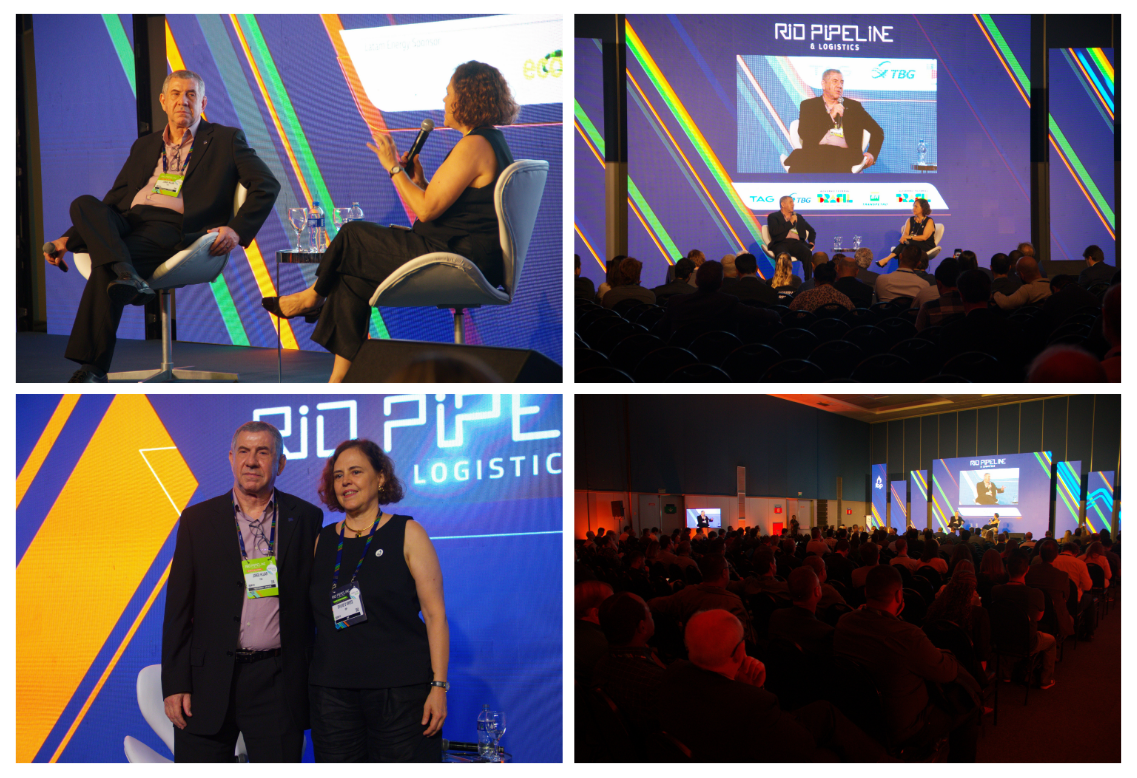

TBG’s chief executive, Jorge Hijjar, participates in “CEO Talks” session at Rio Pipeline
TBG’s chief executive, Jorge Hijjar, participates in “CEO Talks” session at Rio Pipeline


On September 10, the second day of the Rio Pipeline trade show, TBG’s chief executive officer, Jorge Hijjar, took part in the “CEO Talks” session. The executive spoke about his professional career, the regulatory framework for gas market liberalization, the possibilities for importing gas from Argentina’s Vaca Muerta formation, and the company’s Biomethane Hub.
Hijjar, a qualified civil engineer, said he joined the gas sector in 2000, the same year TBG began its full operations, working on the government’s plan to increase gas’ share of Brazil’s energy supplies from 2% to 12%. He was hired by TBG just over 10 years ago, when the National Oil, Natural Gas and Biofuels Agency (ANP) began the process of opening up the market. This involved the regulation of gas transportation tariffs, estimations of resources and reserves, and the harmonization of federal and state legislation. Hijjar spent most of his time since then as the company’s commercial director.
“We worked together with ANP on proposals for a new market liberalization framework, based on the European model. It was a productive partnership based on mutual respect. The issues being raised today regarding asset valuation, for example, were already defined at that time for TBG. Since then, we have been progressively expanding our client base and offering new products. Petrobras is still our largest client in terms of volume, but we have more than 10 very active clients with long- and short-term contracts. We have signed around 500 contracts in 2025 alone. And I already see competition for consumers with a progressive reduction in gas prices. So, what we see here is market competition,” he explained.
As for gas from the important Vaca Muerta reservoir, TBG’s chief executive indicated that of the five possible routes for Argentine gas to reach Brazil, the one that requires the least infrastructure investment is via Bolivia.
“Argentina has to monetize this reservoir. In interruptible terms, Argentine gas has already reached Brazil for four days via the Bolivia-Brazil Gas Pipeline. It was a crucial test to verify logistical and commercial issues, among others. Regardless of the route that Vaca Muerta gas takes to reach Brazil, it is important for it be at a competitive market price,” he pointed out.
Hijjar also spoke about how TBG is prepared to inject biomethane into its network and contribute to the energy transition. “Four years ago, we conducted a study on injecting biomethane into our network and found that there is a concentration of sugar and ethanol plants along TBG’s route. In light of this, we developed a proposal to harness multiple opportunities for receiving biomethane, either through a dedicated pipeline or by truck, in compressed or liquefied natural gas form. The idea is to facilitate logistics and serve different producers with the possibility of scaling up commercialization, since our pipeline reaches the whole of Brazil,” commented the TBG executive, who also highlighted an important issue in the company’s business model, which is currently awaiting approval by ANP.
Hijjar concluded the “CEO Talks” session, moderated by Sylvie D’Apote, executive director for natural gas at the Brazilian Oil and Gas Institute, by saying he was very excited about the booming gas sector in Brazil.
“There is a regulatory emergency together with market growth… I believe we are on the right track. The gas market is not simple, it has its complexities, but it undoubtedly offers great opportunities. We are experiencing a unique moment for a major step forward in the maturity of the gas industry in Brazil,” he said.
TBG’s chief executive also participated in the first day of the event in a panel discussion called “The Opening up of the Market and Regulatory Advances to Expand the Transportation Network,” when he highlighted the importance of regulation for the market’s liberalization and new transportation opportunities.
As well as participating in Rio Pipeline’s panels, TBG reinforced its commitment to operational excellence, sustainability and technological innovation by being a Diamond sponsor of the event. It also presented a robust series of activities at its booth and actively contributed to strategic industry discussions.
During the three-day event, the TBG booth was a meeting point for industry professionals and representatives, hosting technical talks, interactive sessions, immersive digital experiences and presentations of the company’s success stories. See the full schedule of activities on TBG’s website: https://www.tbg.com.br/riopipeline2025
Rio Pipeline 2025 took place between September 9 and 11 at the Expo Cidade Nova convention center in Rio de Janeiro.