

Safety and integrity of the Gas Pipeline
The right-of-way strip: safety and integrity of the Gas Pipeline
The right-of-way strip: safety and integrity of the Gas Pipeline
The right-of way is a 20-meter wide strip of land where the Pipepline is buried. This area is a right of passage granted by Federal Decree from 08/28/1996 and is essential for the safety and protection of the Pipeline. The pipes are buried at an average depth of 1 meter. To protect them from possible damages, the right-of-way must be always signposted and with free accesses in its whole extension.
The right-of-way:
Delimits and protects the Pipeline route;
Identifies the places with installed equipment;
Signs the places where excavations, constructions, occupancy and clearing land by burning are forbidden.
Right-of-way Signposting
All the signposts in the right-of-way are planned so that the nearby community knows the precise location of TBG’s Pipeline
1- Landmarks show the right-of-way limits;
2- Kilometer markers are placed along the Pipeline;
3- Signposts announce the existence of the buried pipeline, with safety warnings and signaling road and railway, transmission lines and river, lake and lagoon crossings.
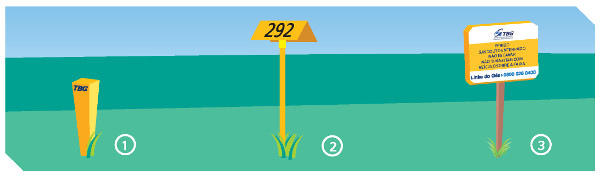
The landmarks and signposts are owned by TBG* and must be preserved. If removed or damaged, they will impair TBG technicians’ routine or emergency interventions and prevent third party’s identification of the place where the Pipeline is buried.
(*) The intentional destruction of goods or properties of others may be qualified as crime, according to Art. 163 of the Criminal Code.
Right-of-way inspections
Three types of inspections are carried out:
From air, by helicopter;
Underwater, made by divers at the crossings with rivers and lakes;
From land, carried out along the pipes, by right-of-way inspectors.
Strip signage
Help the TBG to preserve the operations of the Gas Pipeline and the safety of those who live close to the strip, preventing damage to signs, markers, fences and padlocks.
Rules to be followed:
| PERMITTED | NOT PERMITTED |
|
Cultivate low-lying crops along the entire length of the strip. |
Cultivate taller crops that may block the view of the signs. |
|
Drain all of the water out of the strip, thereby avoiding erosion of the ground surface. |
Using a plough, harrow or other large item of agricultural equipment within the strip. |
|
Cross the strip on foot, by motorbike, car, jeep or cart. |
Cross the strip on a tractor or truck that weighs more than 10 tons per axle. |
In the event that any irregularity is perceived, or to clarify any doubts, please call the Linha do Gás (Gas Helpline) - 0800 026 0400, a toll-free telephone service that operates 24 hours a day, seven days a week.
Contact the TBG, by calling the Linha do Gás (Gas Helpline) - 0800 026 0400 – if you notice:
Any damage to signs;
Any kind of construction within the strip (even if temporary);
Any use of explosives in the vicinity;
Digging or fires;
Effects of nature near the strip, such as: landslides, erosion caused by rain, large fallen trees, etc.